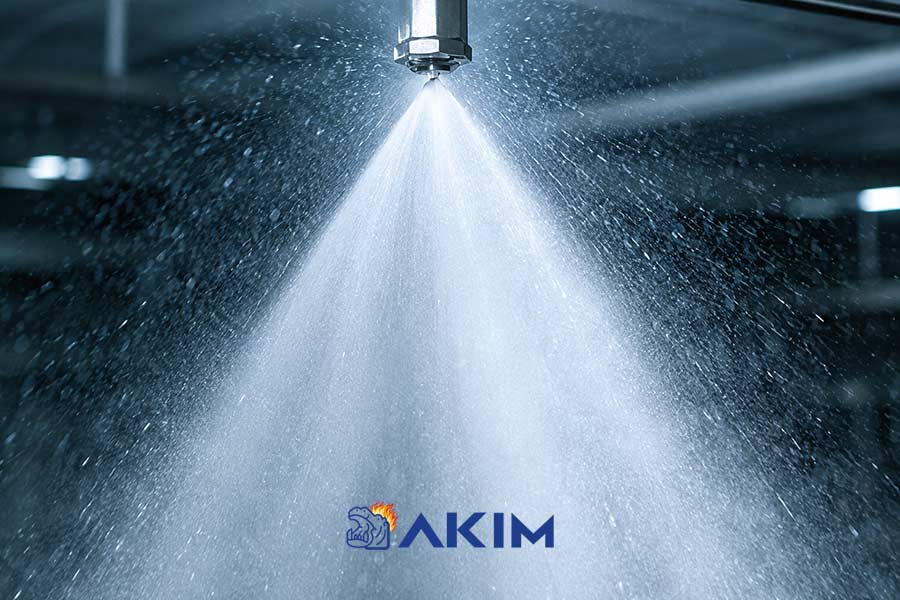
Water Mist Fire Suppression System is one of the modern fire suppression solutions that provides high cooling capacity by producing very fine water droplets during fire intervention. Its ability to use less water compared with conventional sprinkler systems provides a significant advantage, particularly in areas where water damage is a critical concern.
The primary purpose of the system is not only to extinguish flames. Rapidly reducing the temperature of the fire, limiting radiant heat, and restricting the spread of fire to surrounding areas are also important parts of the system's operating mechanism. For this reason, Water Mist systems can be considered for a wide range of applications, from data centers and historic buildings to ships and industrial facilities.
When designing Water Mist systems, the characteristics of the protected area, fire load, equipment configuration, environmental conditions, and the nozzles to be used should be evaluated together. Since the same pressure, flow rate, or nozzle type is not suitable for every facility, it is essential that the application be designed through proper engineering calculations.
Operating Principle
The operating principle is based on breaking water into very small droplets through specially designed nozzles and applying it in a controlled manner to the area affected by the fire. As the surface area of the droplets increases, the water's capacity for evaporation and heat absorption also increases.
When the fire detection system identifies the required conditions, the suppression system is activated. Depending on the system design, water is delivered to the nozzles using high- or low-pressure equipment. The fine water mist discharged from the nozzles creates a rapid cooling effect in the fire area while also helping to reduce heat transfer to the surrounding environment.
Heat Absorption (Cooling)
When fine water droplets reach the hot fire environment, they rapidly heat up and, under suitable conditions, evaporate. During this process, a significant amount of heat is absorbed. This lowers the temperature in the fire area and makes it more difficult for combustion to continue.
One of the key features of water mist technology is its ability to transfer heat effectively due to the large total surface area of the small droplets.
Oxygen Displacement
As the droplets evaporate, water vapor is produced in the surrounding environment. Particularly in the hot zone of a fire, this vapor can contribute to a localized reduction in oxygen concentration around the combustion area.
The objective is not to completely remove oxygen from the environment, but to alter the combustion conditions toward a level at which the fire becomes more difficult to sustain. The primary suppression effect of the system should be considered together with the strong cooling of the fire.
Radiant Heat Barrier
Radiant heat released by a fire can heat surrounding equipment and materials, potentially contributing to fire growth. The fine droplet cloud created by water mist can absorb a portion of the radiant heat and help reduce its transfer to the surrounding area.
This feature is particularly important in applications where the evacuation of people, protection of critical equipment, or delaying the spread of fire to adjacent areas is required.
The Advantages and Features of Water Mist systems are among the main reasons why they are preferred for different types of buildings and facilities today. One of the system’s key advantages is its ability to significantly reduce the amount of water required for fire suppression, depending on the application and system design.
Low Water Consumption
Because very small water droplets are used, designs can provide effective cooling with less water compared with conventional water-based fire suppression applications. This is particularly advantageous in facilities such as ships and yachts, where water storage capacity may be limited.
Reduced Water Damage
Reducing the amount of water used during fire suppression can help limit potential water-related damage following a fire. This is particularly important in areas containing electronic equipment, archives, works of art, or sensitive machinery.
Environmentally Friendly
Water is the primary extinguishing agent used in Water Mist systems. Unlike chemical gases used for fire suppression, properly designed Water Mist applications can provide a solution with a lower environmental impact. However, if additives are used in the system, their characteristics should also be evaluated separately.
Comparison with Conventional Sprinkler Systems
When making a Comparison with Conventional Sprinkler Systems, the most significant difference lies in the structure of the water droplets and the method of application. While sprinkler systems discharge relatively larger water droplets into the fire area at a specified flow rate, Water Mist systems generate a mist consisting of much smaller droplets.
This difference can provide Water Mist systems with advantages such as high heat absorption and, in certain applications, lower water consumption. However, this does not mean that Water Mist is better than sprinkler systems under every condition.
Sprinkler systems are widely used fire protection solutions with established standards and application methods that have been developed over many years. Water Mist systems, on the other hand, are particularly advantageous in specialized applications where reducing water consumption or protecting sensitive areas is important.
Therefore, system selection should not be based solely on water consumption. The fire scenario, building characteristics, risk classification, equipment sensitivity, and applicable standards should all be evaluated together.
The Applications of Water Mist systems are quite extensive due to their low water consumption and effective cooling capabilities. However, the operating pressure, nozzle configuration, and design criteria of the system may vary depending on the application area.
Data Centers and Server Rooms
Servers, network devices, and electronic systems are high-value equipment. During a fire, not only rapid intervention but also the potential damage that may occur after fire suppression needs to be controlled. Therefore, under appropriate design conditions, Water Mist systems can be considered as part of a data center’s fire safety strategy.
Historic Buildings, Museums, and Libraries
Historic artifacts, books, archives, and works of art can be sensitive to water. In such buildings, a careful balance must be established between fire safety and the protection of valuable contents. Due to its low water consumption, Water Mist can be considered for certain specialized protection scenarios.
Ships and Yachts
On ships, water and space limitations are as important as fire risks. Water Mist systems can provide an effective solution in areas such as engine rooms and certain technical spaces when the appropriate engineering criteria are met.
Commercial Kitchens and Hotels
In commercial kitchens, cooking oils, high temperatures, and cooking equipment create significant fire risks. In hotels, the presence of different occupancy areas within the same building requires a comprehensive fire safety approach.
Cable Routes and Tunnels
Fires in cable galleries, technical tunnels, and similar confined spaces can have serious consequences due to the potential for rapid fire spread. With appropriate application design, Water Mist can help cool the fire and limit its spread.
What Are the Advantages?
The answer to the question “What Are the Advantages?” shows that the benefits of the system are not limited to low water consumption. When applied in the appropriate environment, Water Mist technology provides an approach that aims to control the fire while also reducing secondary damage during fire suppression.
Minimal Damage
System designs that use less water than conventional water-based applications can help reduce water damage that may occur after a fire. This feature is particularly important in areas containing critical electronic and mechanical equipment.
Safe for Occupied Areas
Since water is the primary extinguishing agent used by the system, it can be considered for use in occupied areas under appropriate conditions. However, not every Water Mist system should automatically be considered suitable for every occupied environment. Pressure, nozzle type, additives, and the fire scenario must always be evaluated from an engineering perspective.
Smoke Control
Fine water droplets can affect the movement of hot gases and certain particles generated during a fire. Therefore, under suitable application conditions, they may help improve visibility and control the hot smoke layer. However, a Water Mist system does not replace a mechanical smoke exhaust system; appropriate ventilation and smoke extraction design may also be required for smoke control.
Environmentally Friendly
As a water-based fire suppression technology, Water Mist offers an important environmental advantage. It can be a particularly attractive option for applications where permanent chemical residues after fire suppression are undesirable.
In conclusion, Water Mist systems are among the technologies that stand out in fire safety due to their low water consumption, strong cooling effect, and potential to reduce damage in sensitive areas. However, successful implementation requires proper nozzle selection, appropriate pressure and flow calculations, accurate determination of the fire scenario, and project design in accordance with applicable standards.
At Akım Yangın, we provide professional support throughout the design and implementation processes of fire suppression systems by assessing the fire risks of your facility and determining solutions suitable for your needs. You can contact us to determine whether a Water Mist system is suitable for your facility and to develop a solution tailored to your specific application.
The right fire suppression system is designed not only to extinguish a fire, but also to protect life safety, the facility, and critical equipment.
Free Project Analysis
We provide customized solutions tailored to your needs, together with competitive quotations and professional support from our expert team, as quickly as possible.